

How to Reduce Under Eye Puffiness: 7 Fast Fixes
Table of Contents
- Why Your Eyes Look Puffy: The Main Causes of Morning Eye Puffiness
- The 5-Minute Fix: Cold Compress and Lymphatic Drainage Massage for Eyes
- Quick Lifestyle Tweaks: Sleep, Salt, and Hydration to Reduce Under Eye Puffiness
- Your Skincare Arsenal: Best Eye Masks for Puffiness and Ingredient Deep-Dive
- How to Apply Eye Masks and Creams for Maximum Effect
- When Under Eye Puffiness Signals a Deeper Issue
- Your Morning Routine to Prevent Puffy Eyes
- Frequently Asked Questions
Last Updated: September 7, 2026
Why Your Eyes Look Puffy: The Main Causes of Morning Eye Puffiness
Under eye puffiness, medically known as periorbital edema, is the swelling of tissue around the eyes caused by fluid retention in the delicate skin beneath your lower lids. That fluid pools overnight because your circulation slows while you sleep, and gravity pulls excess liquid into the spaces under your eyes.
The skin around your eyes is among the thinnest on your body, measuring roughly 0.5 millimeters thick, and it contains minimal subcutaneous fat, so even small shifts in fluid balance become immediately visible. Several distinct physiological pathways contribute to this fluid buildup:
Sodium and the Renin-Angiotensin System. A high-sodium meal, especially one consumed in the evening, triggers your kidneys to retain water through the renin-angiotensin-aldosterone system. When sodium levels spike, your body holds onto fluid to maintain electrolyte balance, and that excess volume settles in the compliant tissue under your eyes. The American Heart Association recommends limiting sodium to 2,300 milligrams per day, with an ideal limit of 1,500 milligrams for most adults, yet the average American consumes closer to 3,400 milligrams daily (heart.org). That gap explains why salty dinners so reliably produce morning puffiness.
Alcohol and Vasodilation. Alcohol dehydrates your body by suppressing antidiuretic hormone, but dehydration triggers a compensatory release of aldosterone, causing your body to retain fluid once the alcohol is metabolized. Alcohol also causes vasodilation, widening blood vessels around the eyes, which increases visible swelling and redness.
Sleep Position and Venous Drainage. When you sleep flat, your head is level with your heart, which reduces the efficiency of venous and lymphatic drainage from the face. The orbital region relies on a network of lymphatic vessels to clear interstitial fluid, and this system operates largely on gravity and muscle movement. Elevating your head by 30 to 45 degrees, using an extra pillow or an adjustable bed wedge, allows gravity to assist this drainage process throughout the night.
Allergic Inflammation and Histamine Release. Allergic rhinitis triggers mast cells to release histamine, which increases vascular permeability. This means blood vessels in the delicate periorbital area leak fluid into surrounding tissue more readily. Chronic allergy sufferers often develop a characteristic "allergic shiner" appearance, where dark circles and puffiness persist because of ongoing low-grade inflammation. Sinus congestion compounds the problem by blocking the normal drainage pathways that would otherwise carry fluid away.
Age-Related Structural Changes. As skin ages, collagen and elastin production slows, and the orbital septum weakens, allowing fat pads beneath your eyes to herniate forward, creating a structural "bag" distinct from fluid-based puffiness. The American Academy of Ophthalmology notes that permanent bags caused by fat herniation typically require cosmetic intervention rather than lifestyle changes.
Hormonal Fluctuations. For women, estrogen and progesterone levels fluctuate across the menstrual cycle, and both hormones influence fluid balance. Many women report increased under eye puffiness in the days before menstruation, when progesterone levels drop and aldosterone activity increases. Pregnancy and menopause produce similar shifts in fluid retention patterns.
Understanding which mechanism drives your particular puffiness matters because the remedies differ: caffeine-based products work best for vascular puffiness, elevating your head addresses gravitational pooling, and antihistamines are the primary solution for allergy-driven swelling.
The 5-Minute Fix: Cold Compress and Lymphatic Drainage Massage for Eyes
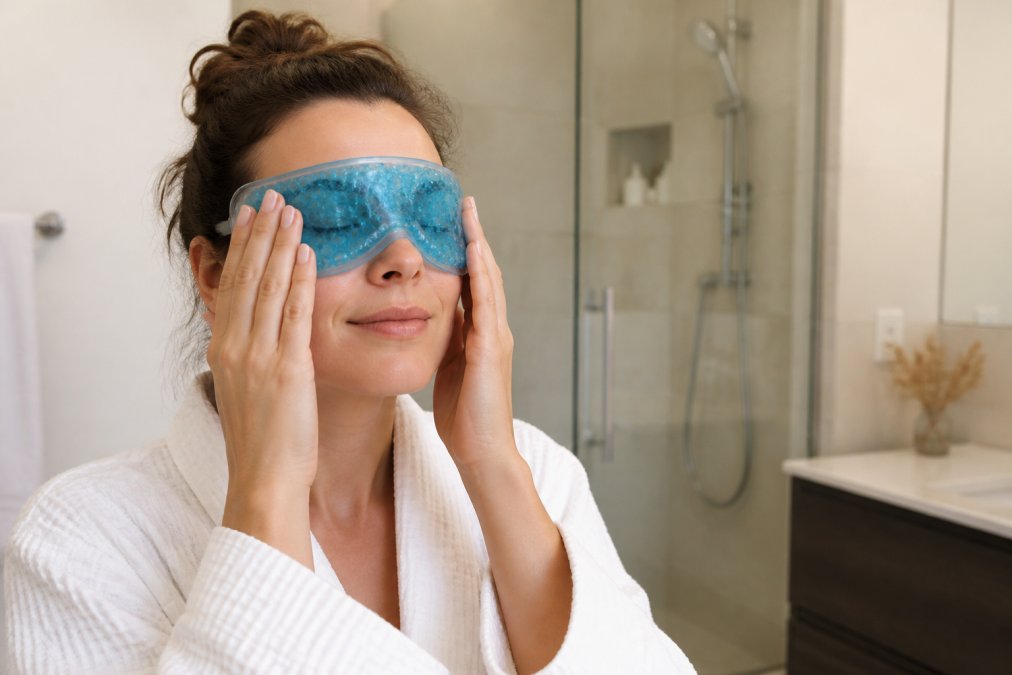
The fastest way to reduce under eye puffiness is a cold compress paired with gentle lymphatic drainage massage, which constricts blood vessels and moves trapped fluid away. Start by applying something cold, like chilled gel eye masks or a wrapped ice pack, for two to three minutes to trigger vasoconstriction.
After the skin feels cool, use your ring fingers to perform light sweeping motions from the inner corner of your eye, along the orbital bone, and out toward your temples. Repeat this stroke five times per eye using gentle pressure, never pulling or dragging the skin, then press lightly at your temples for five seconds.
Quick Lifestyle Tweaks: Sleep, Salt, and Hydration to Reduce Under Eye Puffiness
Daily habits determine whether you wake up puffy or clear-eyed, and adjusting sleep position, sodium, and water intake delivers results within a few days. Elevate your head with an extra pillow so fluid doesn't pool overnight, and aim for consistent sleep hygiene with seven to nine hours per night.
Cut back on salty snacks and processed meals, which drive sodium intake far above recommended levels, and balance your electrolyte intake with potassium-rich foods like bananas and leafy greens. Drink water steadily through the day rather than chugging large amounts at night, and limit alcohol since it dehydrates tissues and triggers inflammation. For allergy sufferers, managing allergic rhinitis with antihistamines reduces the sinus congestion that blocks fluid drainage.
Your Skincare Arsenal: Best Eye Masks for Puffiness and Ingredient Deep-Dive
The best eye masks for puffiness combine cooling physical therapy with active ingredients that target fluid retention, inflammation, and skin firmness. Understanding how these ingredients work at the cellular level, and where they fall short, will help you choose the right formula for your specific type of puffiness.
Caffeine (Methylxanthines). Caffeine works as a vasoconstrictor by blocking adenosine receptors on blood vessel walls, narrowing vessels and reducing fluid leakage into surrounding tissue. Clinical studies using 3% to 5% caffeine have demonstrated measurable reductions in periorbital edema within two hours (PubMed). However, caffeine's effects are temporary, lasting roughly four to six hours, making it ideal for morning de-puffing but insufficient as a standalone long-term solution.
Hyaluronic Acid (HA). HA is a glycosaminoglycan that can hold up to 1,000 times its weight in water (peer-reviewed research). High-molecular-weight HA (above 1,000 kDa) stays on the skin's surface, while low-molecular-weight HA (below 500 kDa) penetrates deeper and stimulates endogenous HA production. The effect on puffiness is indirect, HA doesn't reduce fluid retention, but it makes the skin appear firmer and more elastic, visually minimizing the appearance of bags.
Retinol (Vitamin A Derivatives). Retinol converts to retinoic acid in the skin, triggering increased collagen synthesis and epidermal cell turnover. For under eye puffiness, retinol's value lies in addressing the structural component: thicker skin is less transparent, so underlying blood vessels and fluid are less visible. The trade-off is irritation, so most dermatologists recommend starting with a low concentration (0.01% to 0.03%) applied every other night. Visible results require 8 to 12 weeks of consistent use.
Peptides and Copper Complexes. Signal peptides like palmitoyl pentapeptide-4 (Matrixyl) and copper tripeptide-1 stimulate fibroblasts to produce collagen and elastin. Copper peptides additionally promote angiogenesis, improving microcirculation that supports lymphatic drainage. These ingredients are slower-acting than retinol but significantly better tolerated, making them a practical alternative for sensitive skin.
Vitamin C (L-Ascorbic Acid). Vitamin C is a cofactor for prolyl hydroxylase, an enzyme required for collagen cross-linking. It also neutralizes free radicals generated by UV exposure and pollution, protecting the structural proteins that keep under eye tissue firm. The challenge is formulation: L-ascorbic acid is unstable and oxidizes rapidly when exposed to light and air. Look for products with opaque, airless packaging and concentrations between 5% and 15%, which clinical research shows is the effective range for dermal delivery.
| Ingredient | Mechanism of Action | Best For | Results Timeline | Key Limitation |
|---|---|---|---|---|
| Caffeine | Blocks adenosine receptors, causing vasoconstriction | Immediate fluid-based puffiness and dark circles | Minutes to hours | Effects last only 4-6 hours |
| Hyaluronic Acid | Binds water in the dermis, plumping skin | Fine lines and dehydration-related dullness | Days | Does not address fluid retention |
| Retinol | Upregulates collagen synthesis via retinoic acid receptors | Thinning skin and structural bags | 8-12 weeks | High irritation potential |
| Peptides | Signal fibroblasts to produce collagen | Preventative care and sensitive skin | 4-8 weeks | Slower onset than retinol |
| Vitamin C | Cofactor for collagen cross-linking; antioxidant | Environmental damage and elasticity loss | 4-6 weeks | Formulation instability |
A common mistake is expecting a single ingredient to solve everything. The most effective approach layers complementary mechanisms: caffeine for immediate vasoconstriction, hyaluronic acid for surface hydration, and retinol or peptides for structural reinforcement over time. For those who have recently undergone cosmetic procedures, post-procedure puffiness peaks at 48 to 72 hours, and the FDA advises avoiding retinol and active exfoliants for at least one week. During this window, cold compresses and gentle hyaluronic acid serums are safest, while caffeine products should be avoided for the first few days since vasoconstriction can interfere with filler settling.
Sourir offers 24K gold eye masks designed to reduce dark circles and wrinkles while supporting daily self-care, and the cooling application doubles as your daily cold compress step. The physical barrier of the mask itself creates an occlusive environment that enhances ingredient penetration.
How to Apply Eye Masks and Creams for Maximum Effect
Proper application technique matters as much as the product itself, and most people apply too much product with too much pressure. Start with clean, slightly damp skin so hydrating ingredients absorb more effectively, then follow these steps:
- Gently pat the eye mask or cream along the orbital bone, starting at the inner corner.
- Use your ring finger, which applies the least pressure, to avoid tugging thin skin.
- Apply a thin layer only, since excess product can migrate into your eyes and cause irritation.
- Leave gel masks on for the recommended time, typically 10 to 20 minutes, and relax in a reclined position so gravity doesn't pull the mask down.
- Pat remaining serum into skin rather than rubbing, then follow with moisturizer to seal in hydration.
When Under Eye Puffiness Signals a Deeper Issue
Most morning puffiness resolves within a few hours, but persistent swelling can indicate an underlying health condition. See a doctor if puffiness is severe, painful, or accompanied by redness, itching, or skin changes, since these may signal an allergic reaction or infection. Sudden or one-sided swelling, especially with vision changes, warrants prompt evaluation.
Chronic under eye puffiness can also relate to thyroid conditions, kidney issues, or dermatological concerns that affect fluid balance. While cosmetic intervention like blepharoplasty is an option for structural bags caused by excess fat, genuine medical swelling needs diagnosis first.
Your Morning Routine to Prevent Puffy Eyes
A consistent five-minute morning routine prevents puffiness before it fully develops. Begin with a cold compress or chilled eye mask while your coffee brews, then perform the lymphatic drainage massage described earlier. Apply a caffeine-based eye cream or serum while skin is still damp, followed by your regular moisturizer and sunscreen.
For busy mornings, prepare the night before by chilling your eye masks and setting out your skincare products. Most people notice reduced morning puffiness within one to two weeks of combining these cooling, massage, and ingredient-based strategies.
Reducing under eye puffiness comes down to addressing fluid retention, supporting skin structure, and building a routine you can sustain. The fastest results come from cold compresses and lymphatic drainage massage, while caffeine and hydrating ingredients deliver longer-term improvements. Sourir makes this daily self-care simple with affordable, high-performing eye masks that reduce dark circles and puffiness, backed by quick shipping. Continue shopping with Sourir to find the eye care essentials that fit your morning ritual.
Frequently Asked Questions
What causes puffy under eyes?
Morning puffiness usually comes from fluid retention that gathers in the delicate tissue under your eyes while you sleep. High sodium intake, allergies, sinus congestion, and even crying can trigger it. As we age, skin elasticity drops and a bit of subcutaneous fat can make the area look more swollen. Dehydration also causes your body to hold onto water, which often shows up first around the eyes.
How can I improve my lymphatic drainage under my eyes?
Lymphatic drainage massage for eyes is simple to do yourself. Use your ring fingers to apply gentle pressure, starting at the inner corner of your eye and sweeping outward toward your temples. Repeat this motion 5-10 times. The key is light, sweeping pressure, never pulling or tugging. A cold tool or a chilled eye mask makes the massage even more effective, as the cool temperature helps constrict blood vessels and reduce swelling.
How to get rid of super puffy eyes fast?
For immediate relief, a cold compress is your best bet. Apply a chilled eye mask or a cold spoon for 5-10 minutes. The cold causes vasoconstriction, which shrinks blood vessels and pulls down swelling. Follow this with a quick lymphatic drainage massage. Caffeine-based creams also work fast because caffeine is a vasoconstrictor. If you're short on time, these three steps can visibly reduce puffiness in under 15 minutes.
Are eye masks effective for reducing puffiness?
Yes, the best eye masks for puffiness work through a combination of cooling and active ingredients. Gel masks provide immediate de-puffing through cold therapy, while hydrogel masks can deliver ingredients like caffeine, hyaluronic acid, and retinol deeper into the skin. For best results, store your masks in the fridge. The cold amplifies the effect by reducing blood flow to the area, which directly targets the swelling and fluid retention.